
There’s a particular kind of house share evening that goes like this: you get home with the full intention of doing nothing. Maybe a bath, a book, an early night. And then somehow, forty minutes later, you’re standing in the kitchen holding a glass of wine you didn’t plan to have, deep in a conversation about someone’s work drama, and your “quiet night in” has quietly disappeared.
Before we jump into the rest of this blog, I must confess that I am an extrovert. It would be inauthentic to pretend otherwise. But I know that many people who live in flat shares are the opposite, and there is nothing quite like shared living and having people in your space 24/7 to test even the most extroverted amongst us – myself included, apparently.
Shared living has its real upsides – the built-in community, the split bills, the fact that someone is usually around when you lock yourself out. But if you’re someone who needs alone time to recharge, shared living can start to feel like relentless small talk. Socialising is nice, but so is silence. And sometimes you just want to exist alone.
The good news: you don’t have to choose between having housemates and having space. You just need to get intentional about it.
Let’s start with your bedroom and work outwards, to communal areas, to third spaces, to communicating your needs without making it weird. And finally, why the goal probably shouldn’t be as much alone time as you think.
Make Your Bedroom a Sanctuary for Alone Time (Even in a Shared Flat)
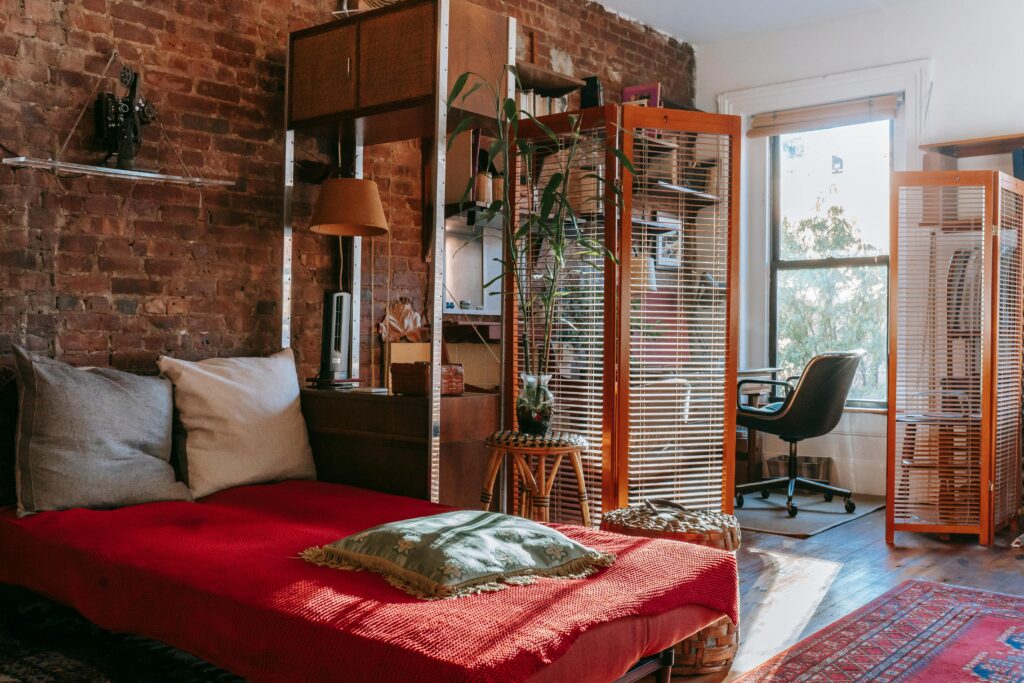
Your bedroom is the one space in the house that is genuinely yours. Most people treat it like a place to work, sleep and store their clothes, but it can be so much more than that.
If you work from your bedroom, create a visual and physical separation between your work zone and your rest zone. It doesn’t need to be dramatic – a folding room divider, or even the habit of putting your laptop away and closing the lid at a set time, can create enough of a psychological shift. I used to hide my monitor after work each evening, and it made a surprising difference in making the room feel more homely and less office-that-I-sleep-in.
Floor space is important too, especially if you’re in a smaller room. A yoga mat’s worth of clear floor space changes the energy of a room. Underbed storage is a total game-changer in small rooms – this ottoman bed is the exact one I have at home. A fold-away desk is worth considering too if your bedroom doubles as an office. Even just rearranging what you keep on display can open things up.
And if you want to create alone time when you can’t physically be alone, get a good pair of noise-cancelling headphones (this one has strong recommendations). They are the most socially acceptable signal that you’re in your own world – no explaining, no awkwardness, just instant “do not disturb” energy.
If your shared spaces are already causing tension, I’ve written a full guide on how to keep a house share clean without resentment.
How to Get Alone Time in a House Share Without Becoming a Hermit
The instinct when you want alone time is to hide in your bedroom like a hermit that only leaves its shell once in a blue moon. The problem: this means you only ever use the living room or kitchen when everyone else happens to be out, which is unpredictable, rare for larger house shares, and starts to feel like you’re living on a visitor’s schedule in your own home.
Once upon a time, I used to think time for myself meant hiding in my room until the house went quiet. But that quickly turned into keeping snacks in my bedroom for when I got hungry, and eating dinner at 10pm, cursing myself when I had indigestion and couldn’t sleep.
When shared living starts feeling tense or overstimulating, it can also overlap with bigger house dynamics. I’ve covered how to handle that in this guide to dealing with difficult housemates.
A better approach is to find your off-peak windows when the communal spaces are naturally quieter and build your routines around them. Golden moments can often be in the early mornings before anyone else is up, just before the workday ends whilst others are still rounding up their final emails, or the end of the day when people have retired to their bedrooms. When your housemates know your rhythms, they also start to read them and adapt accordingly.
If you do share evening TV time, a simple informal norm can help: one or two episodes and then it’s open for someone else. It sounds minor, but it means more than one person can get solo living time in one evening, without anyone feeling like they are hogging the room or being pushed out.
Third Spaces: Where to Go When You Need Alone Time Outside the House
There are only so many rooms in a flat share. At some point, time to yourself means claiming somewhere else as your sacred solo space.
A long walk is an underrated option, particularly if you want to have private phone calls without half the house accidentally listening in. A cheaper version of therapy some might say (by some, I mean me).
Libraries are back and excellent for quiet focus time. Cafes work too if you want background noise without social obligation. Who knew pretending to do ‘life admin’ could actually double as emotional recovery time?
For those amongst us who love a trip to the grocery store, a walk around Tesco can be a strangely grounding experience. The feeling of zoning out of the world, picking out your dinner plans, and existing around people without having to talk to them can be weirdly meditative – depending on how busy it is and how overstimulated you already are.

How to Tell Roommates You Need Alone Time (Without Feeling Awkward)
You don’t need to make a speech about being introverted. But it does help to drop it into conversation naturally before it becomes an issue – something like ‘I tend to need a bit of quiet time in the evenings – nothing personal, I just recharge that way.’ Even I, a self-confessed extrovert, use a similar line once or twice a week. Sometimes, I just want to be on my own.
If boundaries in shared living are something you’re working through more broadly, especially around guests, partners or shared space, this guide on setting boundaries with housemates and partners staying over might help.
Visual signals do a lot of work: a closed bedroom door, headphones on, or even just being visibly settled into something can signal that now isn’t the time without a word being said.
If you’re invited to a movie night and you’re running on empty, a simple ‘I’ll leave you to it, I want to read my book in my room tonight’ is enough. You don’t need to produce an elaborate excuse – just not wanting to join is enough.
The more consistently you set this, the less you’ll feel like you need to justify it. And over time, you’ll likely be asked less too – so just make sure you’re not accidentally shutting yourself off from every social moment.
If you’re actively looking for a new house share and introversion is something you factor into your living situation, look for listings that mention phrases like ‘we all have our separate lives’ or ‘independent housemates’. It’s a reliable signal of what the house culture is actually like and how much space you’ll realistically have.
How to Balance Alone Time and Shared Living Without Feeling Lonely
I’ve definitely been guilty of trying to engineer my life so I have the least amount of interaction possible with the people I live with. At the time it felt like protection, but in hindsight, it often just made the house feel lonelier than it needed to be.
In fact, I would always urge the opposite now. It’s good for us to have social interactions – even if they are small, even if they are a little awkward. Of course, if they are toxic, that’s another story. But in healthy house shares, the goal isn’t avoidance – it’s balance.
The pursuit of space can often tip into something lonelier than intended – timing your meals so you never cross paths with anyone, even if means cooking past the point of hunger; always declining spontaneous invitations, even if it means sitting alone hearing laughter from the next room.
Treating every human interaction as a drain isn’t a healthy way to live. Sometimes even the slightly awkward social moments are what make shared living feel human.
Inconvenience is the price of community. Sometimes the conversation that interrupts your quiet evening is also the one you’ll remember, or the one where you feel most seen by someone who lives alongside you.
Sometimes being alone together – reading in the same room, cooking while someone else watches TV – is its own kind of quiet recharge. It doesn’t look like solitude, but it still feels like mental space.
Protect your alone time for sure. But stay open to the rest as well.
Are you an introvert in a house share, or do you find shared living energising? Drop a comment – I’d love to know how you navigate it.
If you’re also in the process of moving or thinking about changing flat shares entirely, my moving into a house share checklist might be useful when you’re planning your next set up.